
Permaculture: Complete Guide for Beginners
A practical beginner's guide to permaculture principles and techniques, covering everything from zone planning and water management to food forests and soil building for creating sustainable, productive homesteads.
GARDENING
1/21/202610 min read
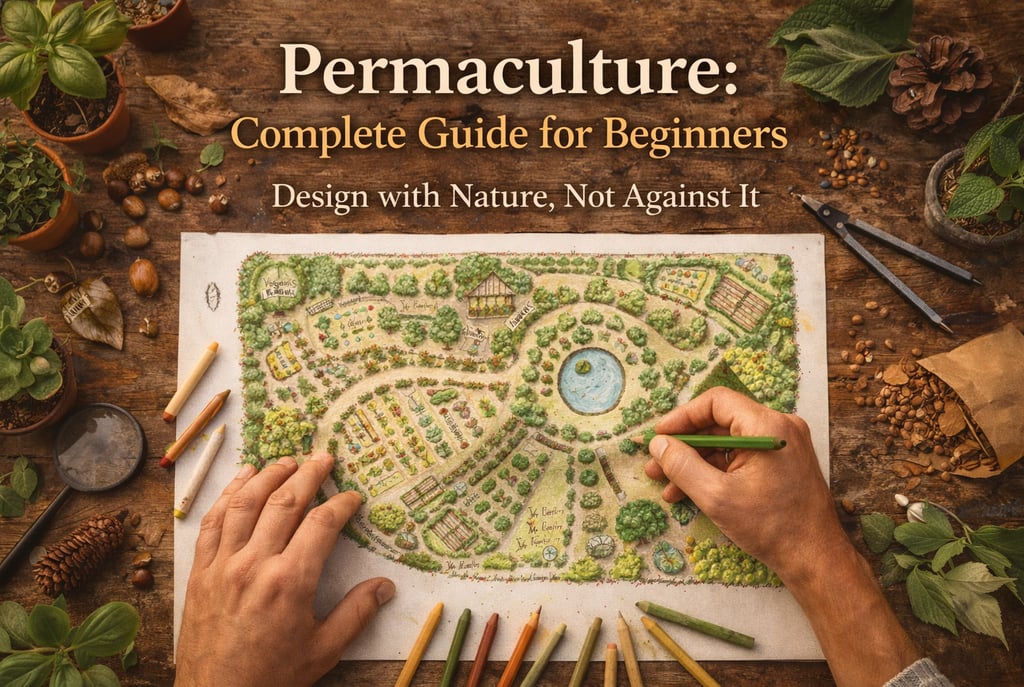
I'll never forget the moment permaculture clicked for me. I was standing in our Michigan garden, hauling yet another bucket of water to thirsty tomato plants during a dry spell, when it hit me: I was working against nature instead of with it. That realization changed everything about how I approach our five-acre homestead.
Permaculture isn't just another gardening trend or some hippie buzzword—it's a practical design philosophy that makes homesteading easier, more productive, and honestly, a lot more interesting. After spending years figuring this out through trial and error, I want to share what I wish someone had told me when I first heard the term and had no idea where to start.
What Permaculture Actually Means
Let's clear up the confusion right away. Permaculture isn't about letting your property turn into a wild jungle (though some people think that's what it means). It's not about being anti-technology or living like it's 1850.
The word itself is a combination of "permanent" and "agriculture"—or alternatively, "permanent culture." At its core, permaculture is about designing systems that work with nature's patterns to create sustainable, productive environments that require less work over time, not more.
Think about a natural forest. Nobody waters it, fertilizes it, or weeds it, yet it thrives year after year, producing food, building soil, and supporting countless species. Permaculture asks: how can we design our homesteads to work more like that forest and less like a constant battle against nature?
The Ethics That Guide Everything
Before we dive into techniques and design, it's worth understanding the three core ethics that underpin all permaculture thinking. These aren't just feel-good concepts—they're practical guidelines that help you make decisions about your land.
Earth Care: Work with natural systems rather than against them. Build soil health, conserve water, and create habitat for beneficial creatures.
People Care: Design systems that meet human needs sustainably. Your permaculture design should make your life better, not harder.
Fair Share: Produce more than you need and share the surplus. This creates abundance and builds community resilience.
I know that might sound a bit abstract, but here's how it plays out in real life: When I sheet-mulched our chicken run instead of using herbicides, I was practicing earth care. When I designed paths that made garden maintenance easier on my back, that was people care. When we share excess eggs with neighbors, that's fair share. Simple, practical decisions guided by these principles.
Understanding Permaculture Principles
Beyond the ethics, there are design principles that help you observe your land and make smart decisions. You don't need to memorize all twelve principles that Bill Mollison and David Holmgren laid out, but a few key concepts will transform how you think about your homestead.
Observe and Interact: Before you change anything, watch your land through all four seasons. Where does water flow? Where does frost settle first? Which areas get full sun versus shade? I spent an entire year just observing our property before making major changes, and that patience saved me from expensive mistakes.
Catch and Store Energy: This applies to water, sunlight, wind, and even human effort. Rainwater barrels are the obvious example, but it's also about mulching to retain soil moisture or planting perennials that produce food year after year without replanting.
Obtain a Yield: Your design should produce something useful. Beautiful is great, but beautiful and productive is better. Every element should serve multiple purposes.
Use and Value Renewable Resources: Solar energy, rain, wind, and biological resources that regenerate themselves should be your first choice. Michelle and I heat our greenhouse partially with compost heat—free warmth from a resource we're creating anyway.
Produce No Waste: In nature, waste from one system becomes food for another. Chicken manure fertilizes the garden. Garden scraps feed the chickens. Kitchen waste becomes compost. Everything cycles.
Starting With Zone Planning
Here's where permaculture gets really practical. Zone planning helps you place elements on your property based on how often you need to interact with them. It's beautifully simple and immediately useful.
Zone 0 (Your House): This is your home base—the center of all activity.
Zone 1 (Immediate surroundings): This is where you put things you access daily. For us, that's our kitchen herb garden right outside the back door, salad greens, and our main chicken coop. I check the chickens twice daily, so having them close makes sense.
Zone 2 (Frequent access): Things you visit several times per week. Our main vegetable garden, berry bushes, and fruit trees live here. It's a short walk from the house but not right on top of it.
Zone 3 (Occasional access): Weekly or monthly visits are fine here. Our larger orchard, main composting area, and storage sheds occupy this zone.
Zone 4 (Semi-wild management): Managed but minimally. We have a section where we harvest firewood, forage for mushrooms, and let beneficial habitat develop.
Zone 5 (Wild zone): Left completely natural. We have about an acre that we never touch—it's habitat for wildlife and a place to observe natural systems.
Pro Tip: Draw your property on paper and mark these zones. Then list what you currently have and where. You'll immediately see inefficiencies—like the time I realized I was walking past three better chicken coop locations to reach our original spot at the far end of the property.
Water: The Life of Your System
If I could only teach one permaculture concept, it would be water management. Water is life on a homestead, and most properties handle it all wrong—rushing it off the land as fast as possible through conventional drainage.
Permaculture flips this thinking: slow water down, spread it out, and sink it into the soil.
Practical water strategies:
Swales: These are level ditches on contour that catch and infiltrate water. We put in three swales above our garden area, and the difference in soil moisture during dry spells is remarkable.
Rain gardens: Low spots planted with water-loving plants that absorb runoff. Beautiful and functional.
Rainwater harvesting: Our gutters feed into 300 gallons of storage tanks. That water gets us through dry weeks without touching municipal water.
Mulch, mulch, mulch: A thick layer of organic mulch reduces water needs by 50% or more. We use straw, wood chips, and leaves depending on the area.
Hugelkultur beds: Buried logs and branches act like sponges, storing water and slowly releasing it to plant roots.
Before implementing any of these strategies, get your garden beds properly prepared so your soil can actually absorb and hold the water you're working to retain.
Stacking Functions: Work Smarter, Not Harder
This is where permaculture gets fun. Every element in your design should serve multiple functions, and every function should be supported by multiple elements.
Take our chickens, for example. They're not just egg producers. They're also:
Garden prep crew (they clear and fertilize beds)
Pest controllers (they eat insects and larvae)
Compost accelerators (their scratching and manure speed decomposition)
Entertainment (seriously, chicken TV is real)
Educators (kids learn responsibility and biology)
Or consider a simple apple tree:
Produces food (apples)
Creates shade (cooling effect in summer)
Provides habitat (birds, beneficial insects)
Builds soil (leaf drop, root exudates)
Windbreak (protects other plants)
Potential income (sell excess fruit)
When you start thinking this way, you realize that the "expensive" fruit tree or chicken coop is actually providing value in five or six different ways. The return on investment is much better than it first appears.
Guilds: Plant Communities That Work Together
In nature, plants don't grow in isolated rows. They grow in communities where different species support each other. Permaculture borrows this concept through plant guilds—groups of plants that work together for mutual benefit.
A basic fruit tree guild might include:
Central tree: Apple, pear, or cherry
Nitrogen fixers: Clover, vetch, or Siberian pea shrub (feeds nitrogen to the tree)
Dynamic accumulators: Comfrey, yarrow (mine deep nutrients)
Pest confusers: Aromatic herbs like thyme, oregano (disguise the tree from pests)
Pollinator attractors: Flowers like calendula, borage (ensure good fruit set)
Ground covers: Strawberries, creeping thyme (suppress weeds, retain moisture)
I have guilds established around our older fruit trees, and the difference is noticeable. Less watering, fewer pests, better fruit production, and the whole area just looks more alive and healthy.
The Permaculture Food Forest
This concept blows people's minds when they first encounter it: imagine a forest that produces food instead of just lumber. That's a food forest—a layered, perennial ecosystem designed to provide abundant harvests with minimal maintenance.
The seven layers:
Canopy layer: Large fruit and nut trees (apples, pecans, chestnuts)
Sub-canopy layer: Dwarf fruit trees, larger shrubs
Shrub layer: Berries like blueberries, currants, hazelnuts
Herbaceous layer: Perennial vegetables and herbs
Ground cover layer: Strawberries, creeping herbs
Root layer: Potatoes, groundnut, other root crops
Vertical layer: Climbing vines like grapes, kiwi, pole beans
We're slowly converting part of our property into a food forest. It's a long-term project—trees take years to mature—but even in year three, we're harvesting berries, herbs, and perennial vegetables from the understory while the trees establish.
The beauty is that once it's established, a food forest requires far less work than an annual vegetable garden. No tilling, minimal weeding, and the plants largely take care of themselves.
Soil Building: The Foundation of Everything
Here's something that separates permaculture from conventional gardening: soil isn't just dirt you plant in. It's a living ecosystem, and building healthy soil is your primary job as a permaculture practitioner.
Key soil-building strategies:
Sheet mulching (lasagna gardening): Layer cardboard, compost, leaves, straw, and other organic materials to build new garden beds without tilling. We've created dozens of productive beds this way.
Cover cropping: Plant specific crops to feed the soil. Clover and vetch fix nitrogen. Buckwheat mines phosphorus. Radishes break up compaction.
Composting systems: We run three different composting systems—hot compost for quick turnaround, cold compost for less effort, and vermicomposting for kitchen scraps.
Minimize disturbance: No-till or minimal-till methods preserve soil structure and the fungal networks that feed plants.
Diversity: Monocultures deplete soil. Diversity builds it. Mix it up.
The goal is to continuously improve your soil so that it becomes more fertile, more alive, and more productive every year. After five years of soil building, our garden beds are unrecognizable from where we started. The proof is in the plants.
Starting Your Permaculture Journey
The biggest mistake beginners make is trying to do everything at once. Permaculture design can feel overwhelming when you're staring at your property thinking about zones, guilds, water systems, and food forests all at the same time.
A practical start-small approach:
Year One: Observe and document. Take photos monthly. Note water flow, sun patterns, frost pockets, wind patterns, and wildlife activity. Start a simple compost system. Plant a few perennials. Read and learn.
Year Two: Implement one major project. Maybe that's installing water catchment, or creating your first guild, or building a small food forest area. Keep observing and documenting.
Year Three: Expand what's working. Add another project. Start seeing the interconnections. Let your chickens into the garden after harvest to prep beds. Use compost to establish new plantings.
Years Four and Beyond: You're not following a plan anymore—you're responding to what your land is telling you. You see opportunities everywhere. The system starts to feel alive and integrated.
Having a comprehensive planning system helps tremendously with this long-term approach.
The Complete Homestead Planner includes sections specifically for tracking seasonal observations, planning projects, and documenting what works on your unique property over multiple years.
Common Permaculture Myths Debunked
Myth: "Permaculture means no maintenance" Reality: It means less maintenance over time, but you still need to observe, prune, harvest, and manage. The difference is that work decreases as the system matures rather than staying constant forever.
Myth: "You need a lot of land" Reality: Permaculture principles work on balconies, suburban yards, and farms alike. It's about design thinking, not acreage.
Myth: "Permaculture gardens look messy" Reality: They can look however you want. Some people prefer a wilder aesthetic; others create incredibly beautiful, orderly designs. Function comes first, but aesthetics are valid too.
Myth: "You can't make money with permaculture" Reality: Perennial crops, value-added products, education, and design consulting all generate income. Many permaculture farms are quite profitable.
Permaculture Resources Worth Your Time
I've wasted money on permaculture resources that were either too theoretical or just plain impractical. Here's what actually helped:
Books that matter:
"Gaia's Garden" by Toby Hemenway (best beginner book, hands down)
"The Permaculture Handbook" by Peter Bane (practical and detailed)
"Edible Forest Gardens" by Dave Jacke (advanced but invaluable)
Online learning:
Geoff Lawton's videos on YouTube (free, practical, global perspective)
Local permaculture groups and garden clubs (real experience in your climate)
Hands-on experience:
Take a PDC (Permaculture Design Course) if you can afford it
Volunteer at permaculture projects near you
Start small experiments on your own land
Pro Tip: Be cautious about advice from permaculture practitioners in dramatically different climates. What works in tropical Australia might not translate to Michigan winters. Seek out examples from similar climates when possible.
The Real Benefits I've Experienced
After five years of applying permaculture principles to our homestead, here's what's actually changed:
Less work: I spend about 30% less time on garden maintenance than I did with conventional methods. Perennials don't need replanting. Mulch suppresses weeds. Water management means less hauling hoses.
Better resilience: During our drought summer two years ago, our permaculture areas outperformed conventional gardens in the neighborhood by a huge margin. The water management systems and soil health made all the difference.
More diversity: We harvest something edible almost year-round now. Beyond the main garden, there are perennial vegetables, berries, nuts, and herbs scattered throughout the property.
Financial savings: Less inputs required means less money spent. No chemical fertilizers, minimal purchased amendments, and water catchment reducing our bills.
Increased property value: Mature fruit trees, established berry patches, and improved soil make our property objectively more valuable than when we started.
But honestly, the biggest benefit is harder to quantify. It's the satisfaction of working with nature instead of fighting it. It's watching systems you designed actually function as intended. It's the moment when you realize the chickens are fertilizing the area that will become next year's garden, and you didn't even plan that—it just emerged from good design.
Making It Work on Your Land
Permaculture isn't about copying someone else's design. It's about understanding principles and applying them to your unique situation—your climate, your soil, your needs, your energy level, your goals.
My five acres in Michigan look completely different from a quarter-acre suburban lot in Texas or a townhouse with a yard in Oregon. And that's exactly how it should be. The principles are universal; the expression is personal.
Start where you are. Observe your land. Make one small change that works with nature instead of against it. Learn from that. Build on it. Give yourself permission to experiment, fail sometimes, and adjust course.
The permaculture journey isn't about reaching some perfect endpoint. It's about creating systems that evolve, improve, and become more resilient over time. Just like nature itself.
Support@rusticrootshomestead.com
© 2024 Rustic Roots Homestead - All rights reserved.