
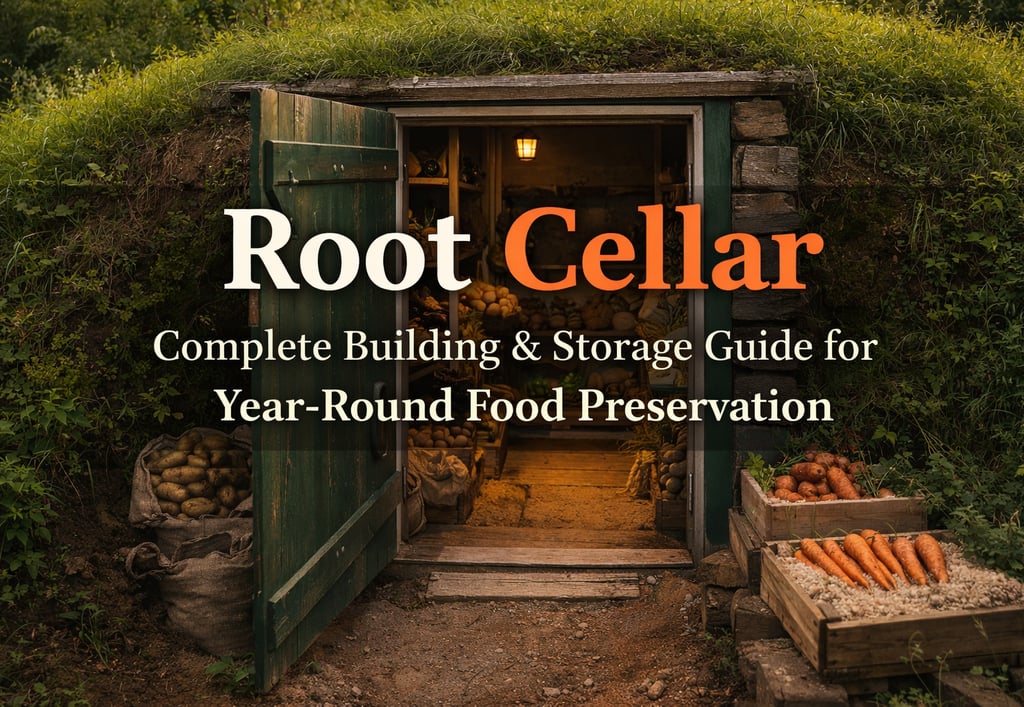
Root Cellar: Complete Building & Storage Guide for Year-Round Food Preservation
A practical, real-world guide to building (or converting) a root cellar that keeps your harvest crisp for 4–8 months—saving money, boosting food security, and letting you enjoy truly fresh homegrown veggies all winter.
GARDENING
1/20/202635 min read
Last Updated: January 2026 | Reading Time: 18 minutes
There's something deeply satisfying about walking down to your root cellar on a cold February morning and pulling fresh carrots from the sand—carrots you grew in your own garden five months earlier. No trip to the grocery store, no wilted produce in plastic bags, just crisp, sweet vegetables that taste like they were just pulled from the ground.
I'll be honest: building my first root cellar felt overwhelming. The excavation alone had me questioning my sanity more than once. But now, years later, it's one of the best investments I've made on the homestead. We're storing hundreds of pounds of produce every year, our grocery bills have dropped significantly, and there's real peace of mind knowing we have months of food right under our feet.
In this guide, I'll walk you through everything I've learned about building and using a root cellar—including the mistakes I made so you don't have to repeat them. Whether you're planning to dig into a hillside or convert a basement corner, you'll find practical advice that actually works in the real world, not just in theory.
Why a Root Cellar Changes Everything
Before I built my root cellar, I was that person frantically canning everything in late summer, staying up until midnight processing tomatoes, and still watching half my harvest go to waste. Winter meant relying on store-bought vegetables that had traveled thousands of miles and cost three times what they should.
A root cellar flipped that script entirely. Now I'm storing fresh produce through the entire winter without running my pressure canner for hours or filling my freezer to capacity. The root cellar does the work naturally—no electricity, no processing, just the earth keeping things cool and humid exactly the way root vegetables prefer.
Here's what surprised me most about having a root cellar:
The food security aspect hit differently than I expected. When you can walk outside and grab fresh vegetables in January, you realize how dependent we've become on grocery stores and supply chains. Having 4-8 months of produce stored (which feeds beautifully into building your emergency food storage strategy) creates a buffer that feels incredibly reassuring.
The cost savings were bigger than anticipated. I calculated we're saving $800-1,200 annually by storing our own harvest plus bulk purchases from local farmers in fall when prices drop. That's real money that paid for the root cellar construction in less than three years.
But honestly? The best part is the quality of food in winter. Fresh beets in December taste nothing like canned beets. Carrots stored in sand develop this concentrated sweetness that you just don't get from refrigerated grocery store carrots. And when you're eating fresh vegetables you grew yourself in the middle of winter, you remember why you started homesteading in the first place.
Choosing the Right Root Cellar for Your Situation
When I started researching root cellars, I got overwhelmed by all the different designs. Should I dig a massive hole in the backyard? Convert part of the basement? Build into a hillside? Everyone had strong opinions, and honestly, most of them contradicted each other.
Here's what I learned: the "best" root cellar is the one you'll actually build and use. I've seen elaborate plans that never got past the drawing stage, while simple basement conversions are feeding families year after year. Let me walk you through the main options and help you figure out what makes sense for your property and situation.
The Traditional In-Ground Root Cellar
This is what most people picture—a separate underground structure accessed by steps or a sloped entrance. It's the gold standard for temperature control, and if you have the space and energy for the project, it's hard to beat.
I won't sugarcoat it: digging a hole 8 feet deep and 10 feet across is serious work. When I built mine, I spent three weekends just on excavation, and my back reminded me about it for weeks afterward. But that effort pays off in rock-solid temperature control. Once you're 6-8 feet underground, you're tapping into the earth's natural stability—it stays around 50-55°F year-round, and proper ventilation brings that down to the ideal 32-40°F range.
This works best if you have: Rural property with good drainage, room for excavation, and you're committed to a permanent structure. It's definitely the biggest upfront investment in time and materials, but it'll outlast you if built properly.
The reality check: You might need permits. Drainage can be tricky if you have clay soil or a high water table. And yes, it's hard physical work. But if you want the most storage capacity and the best temperature control in any climate, this is your answer.
Converting a Basement Corner
This is where I started before building my standalone cellar, and honestly, if you have an unfinished basement, this might be all you need. You're basically walling off a corner (usually 6x8 feet minimum) along a north-facing exterior wall and setting up proper ventilation.
The beauty of this approach is you're leveraging structure that already exists. No massive excavation, no wondering if the ceiling will hold, and you can access your stored food without putting on boots and trudging outside in a snowstorm (which matters more than you'd think in January).
This works best if you have: An unfinished basement in a cold climate and you keep the basement unheated. The concrete walls do a decent job of staying cool, especially along exterior walls. I've seen basement root cellars in homes from Michigan to Montana working beautifully.
The limitation: In warm climates (zones 8-10), basement temperatures might not drop low enough consistently. And if your basement is heated or houses your furnace, you're fighting an uphill battle. But for many homesteaders, this is the practical, achievable option that gets you storing food this year instead of "someday."
Building Into a Hillside
If you've got sloped terrain on your property, you have a natural advantage. Building into a hillside splits the difference between a full in-ground cellar and a basement conversion—you get excellent earth insulation without having to excavate as much.
I love this design for its aesthetics. When done right, you can barely see it from certain angles, just a door built into the hill. The earth provides all the insulation you need on three sides, and the entrance is relatively easy to access since you're walking more or less level into the hillside.
The trick is drainage. Water naturally runs downhill, so you need to think carefully about directing water away from your entrance. I've seen beautiful hillside cellars that turned into swimming pools after spring rains because the builder didn't account for runoff.
This works best if you have: Natural slopes on your property and you're comfortable with some excavation work. It's often easier than digging straight down because you're removing dirt horizontally into the hillside rather than hauling it all straight up.
Starting Small: Above-Ground Alternatives
Not everyone is ready to commit to a major construction project, and that's completely reasonable. I've seen people create functional storage using much simpler methods while they save up or plan for something more permanent.
The buried garbage can method works surprisingly well for a season or two. You're basically burying a clean metal garbage can at a 45-degree angle, layering your root vegetables with straw, and covering with an insulated lid. It's not elegant, but it'll keep 30-40 pounds of potatoes and carrots fresh through winter for an investment of maybe $50.
Buried coolers are another option—a large cooler buried in a shaded spot with a PVC pipe for ventilation. Again, not a long-term solution, but it's functional and lets you test whether you'll actually use a root cellar before investing in permanent construction.
The honest truth? These methods taught me a lot about what I actually needed before I built my real root cellar. If you're not sure whether this is for you, start small. You can always scale up later.
What Makes a Root Cellar Actually Work
Here's something I wish someone had told me clearly from the start: a root cellar isn't complicated, but it does require getting four things right. Miss any one of these, and you'll be dealing with sprouted potatoes, shriveled carrots, or moldy cabbage. Get them all dialed in, and you'll be amazed at how well everything keeps.
Keeping It Cold (But Not Too Cold)
The magic number is 32-40°F. That's cold enough to slow down decay and sprouting, but warm enough that nothing freezes. The beautiful thing about going underground is that once you're 6+ feet deep, the earth naturally sits around 50-55°F year-round in most regions. Your job is just fine-tuning that down to the sweet spot.
I learned this the hard way my first winter. I was so excited about having cool temperatures that I left my ventilation wide open during a cold snap. Walked down one morning to find my carrots frozen solid. They're technically still edible once thawed, but the texture is never quite the same. Now I keep a min/max thermometer down there and actually check it regularly instead of assuming everything's fine.
Temperature swings are your enemy. If it's bouncing up and down by 15-20 degrees, your vegetables will start sprouting or breaking dormancy. The whole point of a root cellar is that stable, consistent cold that tells your potatoes "it's still winter, stay asleep."
Humidity Is Your Friend (Really)
This one trips people up because we're so conditioned to think "dry storage" for food. But root vegetables are different—they're still alive, still respiring, and they need moisture in the air to stay crisp and fresh. You're aiming for 85-95% humidity for most crops.
Without enough humidity, your carrots and beets will shrivel within weeks. I've seen beautiful carrots turn into something resembling beef jerky because someone stored them in too-dry conditions. Not a fun discovery.
The fix is simpler than you'd think. A dirt floor naturally releases moisture into the air. I sprinkle mine with water every week or so if things feel dry. Some folks keep buckets of water in corners. I've even seen people drape damp burlap over stored vegetables. Whatever works.
A cheap hygrometer (humidity meter) is worth every penny. I keep mine at crop level, not up near the ceiling where readings can be misleading. When humidity drops below 80%, I know it's time to add some moisture.
Ventilation: The Secret Ingredient
This is where a lot of root cellars fail, and it's such a shame because ventilation isn't that hard to get right. You need fresh air circulation to prevent mold growth and to remove ethylene gas (which vegetables emit and which accelerates ripening and spoilage).
The two-pipe system is your friend. One pipe brings cool fresh air in near the floor. Another pipe lets warm stale air out near the ceiling. Physics does the work—warm air rises and exits, pulling fresh cool air in through the intake. No electricity, no fans, just natural convection.
I use 4-inch PVC pipes for both, and I installed simple dampers (basically adjustable covers) on each pipe opening outside. In fall when I'm trying to cool things down quickly, I open them fully. In deep winter when it's below zero, I close them partially to prevent freezing. In spring, I open them wide again to dry everything out.
The mistake I see people make is thinking they can skip ventilation or that a single pipe will work. It won't. Stale air plus high humidity equals mold city. Trust me on this one.
Keeping Water Out While Keeping Humidity In
Yes, I know this sounds contradictory. You want humid air but dry surfaces. The distinction matters more than you'd think.
Water infiltration—actual liquid water getting into your root cellar—is a disaster. It rots vegetables, creates standing puddles that breed mold, and can undermine your structure. I'm talking about groundwater seeping through walls or rainwater draining toward your entrance.
This is why drainage work matters so much during construction. The ground around your root cellar needs to slope away from it, not toward it. If you're in an area with high water table or clay soil that doesn't drain well, you might need French drains around the perimeter or even a sump pump.
Inside, a gravel floor base (6-8 inches) topped with sand or dirt handles any minor moisture while still allowing that beneficial humidity to rise into the air. I learned to never use sealed concrete floors—they trap moisture underneath and create damp problems you can't see until it's too late.
The exterior walls need waterproofing before you backfill. This isn't optional. I've seen people skip this step to save $100, then spend ten times that fixing water damage later. Don't be that person.
Building Your Root Cellar: What You Actually Need to Know
Let me start with this: building a root cellar isn't rocket science, but it is real work. When I was planning mine, I got paralyzed by all the technical details and conflicting advice online. Some sources made it sound like you needed an engineering degree, while others glossed over critical steps.
The truth is somewhere in between. You need to understand the principles (which we just covered), and you need to be methodical about a few key construction points. But you don't need to be perfect, and you definitely don't need fancy equipment or advanced skills.
I'm going to walk you through the process I followed, including the mistakes I made and what I'd do differently. Take what's useful for your situation and adapt the rest. Every property is different, and your root cellar should fit your specific needs, not some idealized textbook version.
Finding the Right Spot
This matters more than almost anything else. I almost built mine in the lowest part of my yard because, well, it was easier to dig there. Thank goodness someone talked me out of it—that spot turns into a swamp every spring.
Look for these things when choosing your site:
Water drainage is non-negotiable. Walk your property after a heavy rain and see where water collects. Those spots? Cross them off your list immediately. You want higher ground where water naturally drains away, not toward your structure.
Accessibility matters more than you think. Mine is about 75 feet from the house, which feels reasonable when I'm hauling out carrots in October. In January during a blizzard? I sometimes wish it were closer. Think about how you'll actually use this throughout the year.
Soil type affects everything. Clay soil is excellent for insulation but terrible for drainage—you'll need more drainage work. Sandy soil drains beautifully but doesn't insulate as well. I have clay, which meant extra French drain installation but great temperature stability once I dealt with the water.
Shade is helpful but not critical. North-facing locations or spots under trees keep the entrance area cooler and make summer maintenance easier. But don't let lack of perfect shade stop you—you can always plant fast-growing trees nearby.
One more thing: Check with your local building department before you start digging. I know, I know—nobody wants to deal with permits. But some jurisdictions require them for permanent structures, and it's a lot easier to get approval before you build than to explain afterward why you didn't.
What You'll Actually Need
I'm going to give you a realistic materials list for an 8x10 foot in-ground cellar, which is a good size for most families. Scale up or down based on your needs, but this will give you the framework.
The major structural stuff:
You'll need concrete blocks or poured concrete for the walls. I went with blocks because I could work at my own pace without worrying about concrete trucks and perfect weather conditions. Figure 400-600 blocks depending on how deep you're going. Yes, that sounds like a lot. Yes, it is a lot. But you stack them over time.
Pressure-treated lumber for ceiling joists—about 20-30 boards of 8-foot 2x6s. Don't cheap out on the lumber quality here. These are holding up literally tons of earth.
Plywood for the ceiling (8-10 sheets of 3/4-inch exterior grade), roofing materials for waterproofing, and a good insulated exterior door with weather stripping. The door seals matter enormously for maintaining temperature and keeping out critters.
Insulation and waterproofing (don't skip this):
Rigid foam insulation for the ceiling (2-inch thickness), foundation waterproofing for the exterior walls (I used about 5 gallons for my 8x10), gravel for the floor and drainage (2-3 tons), and sand for the floor surface (about 1 ton).
Your ventilation system needs:
4-inch PVC pipe (20-30 feet total for two pipes), elbows and connectors, screen mesh to keep insects out, and some way to make adjustable dampers. I built mine from plywood circles on hinges, but you can get fancier if you want.
Tools you probably already have: Shovel, pickaxe, level, concrete mixing supplies, basic saw, drill, measuring tape, wheelbarrow. Nothing exotic.
The real cost: When I built mine, materials ran about $2,000. I've seen people do it for $1,500 if they scrounged some materials, and I've seen others spend $3,000 for a slightly larger or better-appointed version. Figure on that range for DIY.
The labor is significant—I spent probably 60-70 hours total, spread over several weekends. If you hire it out, you're looking at $4,000-8,000 depending on your area. That's not pocket change, but when you consider it's a one-time investment that will serve you for 50+ years, the math works out.
The Digging Part (Let's Be Real About This)
Excavation is where the romance of homesteading meets the reality of moving literal tons of dirt. I'm not going to pretend this part is fun. It's hard, sweaty work, and by the end of the first weekend, you'll be questioning your life choices.
But here's the thing: it's also doable. I'm not some super-fit excavation expert. I'm a regular person who dug a hole over three weekends with a shovel, a pickaxe, and sheer stubbornness. You can too.
Mark out your perimeter with stakes and string—the actual size plus about 2 feet extra on all sides so you have working room. This is when the project stops being theoretical and becomes very, very real. That's a big hole you're about to dig.
I went down 7 feet, which put me well below the frost line and into stable earth temperatures. Some people stop at 6 feet, some go to 8. The deeper you go, the better your temperature stability, but also the more dirt you're moving. Find your balance.
A few things I learned the hard way:
Save your topsoil separately. Seriously, pile it off to one side. You'll use it later to cover the roof, and topsoil is valuable stuff. Everything below that can go in a different pile.
Work in stages. Don't try to dig the whole thing in one weekend unless you want to wreck your back. I did about 2 feet deep per weekend, which felt sustainable and gave my body time to recover.
The floor needs to be flat and level. I got lazy about this initially and paid for it later when I was trying to install my drainage system. Take the extra time to get it right.
Once you're down to depth, install your floor drainage—a perforated drain pipe in a gravel bed that slopes gently toward an outlet (daylight or sump pump). Then add your 6-8 inches of crushed gravel for the base, top it with sand, and you have your floor.
Expect this whole excavation phase to take 20-40 hours depending on your soil type and whether you're using any machinery. I did it by hand. Some people rent a small excavator for a day and knock it out much faster. Do whatever works for your budget and situation.
Putting Up Walls and a Roof
With your hole dug and floor in place, you're ready for the actual building part. This is where it starts feeling like a real structure instead of just a big pit in your yard.
I used concrete blocks for my walls because I could work at my own pace. Some people pour concrete, which is faster if you can afford the concrete truck and have helpers to manage the pour. Both work fine. Concrete blocks are just more forgiving for a solo builder.
You're basically building up from the floor, course by course, keeping everything level and plumb. Fill the cores of the blocks with concrete for strength—you're going to have thousands of pounds of earth pressing against these walls. This isn't the time to cut corners.
Before you backfill around the outside, waterproof those exterior walls. I used foundation waterproofing coating, brushed on thick. This is your protection against groundwater seepage. Skip it, and you'll regret it the first time you get heavy rain.
Leave an opening for your door. I put mine on the east side, which gives me morning sun on the entrance but avoids the worst of prevailing winds. South works too. I'd avoid north if you're in snow country—you don't want to be shoveling out your root cellar entrance after every storm.
The ceiling is critical because it's holding up all that earth you're going to pile on top:
Run pressure-treated 2x6 joists across the top of your walls, spaced 16 inches apart. Don't space them wider thinking you'll save lumber. The load is real.
Cover with 3/4-inch exterior plywood. This isn't a subfloor for a house—it's load-bearing structure. Get good quality stuff.
Add your rigid foam insulation on top (2 inches works well), then a waterproof membrane. I used heavy-duty roofing material because I didn't want any surprises about water getting through.
Now comes the satisfying part: covering it all with earth. You want 12-18 inches minimum. I went with 18 inches and then put topsoil on top so I could grow grass. From a distance, you'd barely know there's a root cellar there.
Installing your door properly matters more than you'd think. Frame the opening with pressure-treated lumber, install an insulated exterior door that swings outward (trust me on the outward swing—you don't want to deal with inward-swinging doors when you're carrying armloads of produce), and add good weather stripping for an airtight seal.
Some people build a small vestibule or angled stairway to keep wind from blasting directly in when you open the door. I didn't do this initially and wished I had. It makes a noticeable difference in maintaining temperature stability.
Getting Ventilation Right
Here's where some people get lazy and end up with a moldy mess. Don't skip proper ventilation. I promise you, it matters.
The two-pipe system isn't complicated. You're installing one pipe low (about 6 inches off the floor) that brings fresh air in, and another pipe high (near the ceiling) that lets stale warm air out. Natural convection does all the work—warm air rises, exits through the top pipe, and pulls cool fresh air in through the bottom one.
I used 4-inch PVC pipe for both, which is plenty for an 8x10 cellar. Run your intake pipe down to about 6 inches above floor level inside, then extend it up and outside to about a foot above ground level. Do the same with your exhaust pipe, but position the interior opening near the ceiling.
The details that matter:
Cover the exterior openings with fine mesh screening. You don't want insects, mice, or curious chipmunks setting up house in your root cellar. I learned this after finding a mouse nest in my intake pipe the first fall. Screen solved it permanently.
Install some kind of adjustable damper on each pipe. I made simple ones from plywood circles that slide over the pipe openings outside. In fall when I'm trying to cool the space quickly, I leave them wide open. In January when it's 10 below, I close them partway to prevent freezing while still allowing some air exchange.
Test your airflow by lighting a candle and holding it near each pipe opening inside. You should be able to see the flame react to air movement. If you don't, something's blocked or your pipes aren't positioned right.
This whole ventilation setup took me maybe 3-4 hours to install and has worked flawlessly for years. It's one of those things that's dead simple but absolutely essential.
Setting Up Storage Inside
Once your structure is built, you need shelves and storage containers. This is actually the fun part because you're visualizing how you'll use this space all winter.
I built simple slatted shelves from pressure-treated lumber. Nothing fancy—just functional shelving that allows air to circulate around and between stored crops. Solid shelves would trap air and create dead spots where mold could develop.
What I learned about shelf design:
Space them 12-18 inches apart vertically. This gives you room for bins and crates while maximizing your storage capacity. I went with 18 inches and sometimes wish I'd done 15—it's a bit of wasted vertical space.
Build them 18-24 inches deep. This matches standard wooden crates and plastic bins perfectly. Deeper feels excessive, shallower is annoying because containers overhang.
Leave a 6-inch gap between the back of your shelves and the wall. Air needs to circulate behind everything, not just in front. This gap matters more than you'd think for preventing mold.
For containers, I use a mix:
Wooden crates with slatted sides are perfect for root vegetables packed in sand. I picked up a bunch from a farm supply store pretty cheaply.
Plastic bins with perforations work great, but avoid anything airtight. Your vegetables need to breathe. I drilled extra holes in some solid bins I had lying around—works fine.
Wire mesh bins are excellent for onions and garlic since they get maximum airflow.
Cardboard boxes work for apples, though you'll need to replace them every year or two as they deteriorate from the humidity.
Heavy-duty burlap bags hung from ceiling hooks are traditional for potatoes, and honestly, they work beautifully.
I keep a simple inventory log on a clipboard near the door. Nothing elaborate—just what I stored and when, so I can rotate stock and use older items first. It takes 30 seconds when I'm loading things in fall, and saves me from guessing later.
What Actually Stores Well (And What Doesn't)
This is where theory meets reality. Not everything from your garden belongs in a root cellar, and some crops that seem like they should work actually don't. Let me walk you through what I've learned works consistently.
Root Vegetables: The Stars of the Show
These are what root cellars were invented for, and they absolutely shine when stored properly.
Carrots are my favorite success story. Pack them in damp sand in wooden crates—not washing them first, just brushing off excess soil—and they'll stay crisp and sweet for 4-6 months. I'm talking like-they-were-just-harvested fresh in February. The trick is keeping that sand slightly moist. Not wet, not dry, just damp enough that it clumps when you squeeze it.
Twist off the green tops but leave about an inch of stem. Check them monthly and pull out any that feel soft. One bad carrot won't ruin the whole bin if you catch it early.
Beets store almost as well—3-5 months easily. Same method: pack in damp sand, remove the tops (leave that inch of stem), and forget about them until you want borscht. Smaller beets last longer than baseball-sized ones, though the big ones are fine for the first few months.
Potatoes are the workhorse of root cellar storage. Done right, they'll last 5-8 months. But you can't just toss them in and hope for the best.
First, cure them for two weeks at 50-60°F before moving them to cold storage. This lets any small cuts or bruises heal over. Then store them in burlap bags or ventilated bins in complete darkness—and I mean complete. Any light exposure and they'll turn green (which is mildly toxic and tastes terrible).
Brush off the soil but don't wash them. Moisture on potatoes leads to rot. Check them every few weeks for soft spots. One bad potato really can spoil the batch if it gets too far gone.
Turnips, rutabagas, and parsnips all store beautifully—4-6 months in damp sand. Parsnips are especially forgiving and actually get sweeter after some frost exposure. These are some of the easiest vegetables to store long-term.
Onions and garlic are the rebels of the root cellar—they need different conditions than everything else. They want it drier (60-70% humidity instead of 90-95%) and they need serious air circulation.
Cure them thoroughly first. I mean bone-dry necks, papery skins, the works. Then store them in mesh bags or braided and hung from the ceiling. Keep them away from your high-humidity root vegetables if possible—I hang mine near the exhaust vent where it's driest.
Check them regularly and remove any showing soft spots. When onions go bad, they go bad spectacularly, and the smell will let you know you've waited too long.
Winter Squash: The Warmer Corner
Butternut, acorn, and Hubbard squash prefer slightly warmer, drier conditions than root vegetables—around 50-60°F and 70% humidity. I position them on my highest shelves where it's naturally warmer.
The key is curing them properly first. Butternut squash needs about 10 days at 80-85°F before storage. That hard skin you see? It's not hard enough until it's been cured. After that, they'll store 3-6 months depending on variety. Butternut and Hubbard are the champions here. Acorn squash is more like 2-3 months.
Keep the stems attached, and check them regularly. When the stem dries up and falls off, use that squash soon because it won't last much longer.
Pumpkins are trickier—only thick-skinned varieties store decently, and even then you're looking at 2-3 months. Use those first.
Apples: High Maintenance But Worth It
Storage varieties like Fuji, Granny Smith, and Arkansas Black can last 3-6 months. Early season apples? Don't even bother—they'll be mealy within weeks.
Here's the thing about apples: they emit ethylene gas like crazy, which accelerates ripening in everything around them. So you either need to keep them completely separate from other produce, or store them in perforated plastic bags to contain the gas somewhat.
I check mine weekly and remove any showing brown spots immediately. One brown apple really does spoil the bunch—that's not just an expression.
Wrapping each apple individually in newspaper extends storage life significantly. Yes, it's tedious. Yes, it's worth it if you're trying to make apples last into March.
Cabbage: Surprisingly Good Storage
Late-season cabbage varieties will store 3-4 months if you do it right. Pull the entire plant with roots attached if you can, then hang it upside down or wrap it in newspaper.
The outer leaves will deteriorate, so peel those off as needed. The head inside stays fresh. It's a bit rustic looking, but it works.
What Doesn't Belong Here
Don't waste space trying to store cucumbers, summer squash, tomatoes (unless they're green and you're trying to ripen them gradually), bell peppers, lettuce, or corn. These all need different preservation methods—canning, freezing, or fresh consumption.
I learned this the hard way trying to store slicing tomatoes my first year. Total waste. They went moldy and soft within two weeks.
Keeping Things Running Smoothly Through the Seasons
A root cellar isn't a "set it and forget it" situation. It needs attention, though honestly not that much. I spend maybe 20-30 minutes every couple of weeks checking on things, and a few hours each season doing deeper maintenance. It's one of those investments where a little regular attention prevents big problems.
What I Check Regularly
Temperature and humidity get checked weekly during fall and winter when I'm actively storing crops. I keep a min/max thermometer down there so I can see if there were any wild swings even when I wasn't around. The humidity gauge sits at shelf level—not up by the ceiling where readings can be misleading.
If temperature creeps above 45°F, I know I need to increase ventilation. Below 35°F and I'm risking freezing, so I close the vents partway. It's a constant dance in fall and spring when outside temperatures are swinging, but it becomes second nature pretty quickly.
Every two weeks I inspect the produce itself. I'm looking for soft spots, mold, or anything starting to sprout. One bad vegetable can spread problems to its neighbors, so I pull anything questionable immediately. Don't try to save it—just toss it and move on.
I reorganize as I go, moving older stock toward the front so we use it first. This rotating system has saved us from waste more times than I can count.
Monthly ventilation checks are simple but important. Walk outside and make sure nothing's blocking your pipe openings—leaves, snow, curious animals, whatever. Verify air is actually flowing by testing with a candle inside. Adjust dampers based on the weather forecast and current outside temperature trends.
In extreme cold (I'm talking single digits or below), I'll insulate the pipes with some foam wrap to prevent them from freezing solid while still allowing air exchange.
How Maintenance Changes With the Seasons
Fall is all about preparation (September-October). Before I start loading in the harvest, I give everything a deep clean. Sweep down the shelves, sprinkle fresh sand on the floor if needed, check all the seals and weather stripping on the door for gaps.
This is when I maximize ventilation to cool the space down quickly. Those warm September days need cool nights to do the work, so I open those dampers fully and let physics do its thing.
Any repairs or improvements I noticed last spring? Now's the time to fix them before I'm relying on this space daily.
Winter is maintenance mode (November-March). I'm checking temperatures more frequently because outside conditions are changing constantly. A cold snap means partially closing vents. A January thaw means opening them back up.
I watch for frost buildup around the door seal—if I see it, that's a clue I need better weather stripping or I'm getting too much humid air escaping.
Ice forming around ventilation pipes is normal in extreme cold, but if they freeze completely shut, I need to add more insulation wrap or adjust the dampers.
Spring means clearing out (April-May). By now we've eaten most of what we stored, and what's left is getting pulled out. Time for a thorough cleaning before summer heat settles in.
I increase ventilation fully to dry everything out. Any vegetables showing signs of life (sprouting, going soft) get composted. The space needs to completely dry before summer.
This is prime time for structural repairs. Fix any cracks, check waterproofing, make sure drainage is still working properly. It's much easier to do this work when the cellar is empty.
Summer is rest and repair (June-August). The root cellar gets to breathe. I leave ventilation wide open to keep air moving and prevent mustiness. The space naturally warms up, which is fine—nothing's being stored anyway.
I use this time to reorganize shelving if needed, make improvements I've been thinking about, and generally get ready for another season. Maybe I'm building additional shelves or improving the entrance area. Whatever projects got deferred during the busy season, summer is when they happen.
When Things Go Wrong (And How to Fix Them)
Look, problems happen. I've dealt with every issue on this list at some point, and I'm still here with a functioning root cellar. Most problems are fixable if you catch them early, and the solutions are usually simpler than you'd think.
It's Too Warm In There
My first fall, temperatures stayed stubbornly around 50°F when I needed them in the 30s. Frustrating doesn't begin to describe it.
The fix: I increased ventilation dramatically during the coolest parts of the night. I'd open those dampers fully around 8 PM and partially close them mid-morning. This actively circulated cold night air through the space.
I also added more insulation to my ceiling the following summer. Turns out 2 inches of foam wasn't quite enough with only 12 inches of earth on top. Now I have 18 inches of earth coverage and better temperature control.
If your space runs consistently warm even with maximum ventilation, you might need to add earth covering or, in extreme cases, dig deeper next season. Some people in warmer climates install a small fan to force air exchange during the coolest hours, though that defeats the no-electricity benefit.
The Air Feels Dry
When my humidity dropped to 65% one winter, I noticed my carrots shriveling within weeks. Not good.
Quick fixes that work: I started sprinkling the dirt floor with water once a week. Not soaking it, just a light sprinkle from a watering can. Humidity bounced right back to 85-90%.
I also placed a couple of open pans of water in the corners. As the water evaporates, it humidifies the air naturally. Simple, effective, costs nothing.
If you're battling persistent dryness, check your ventilation—you might be exchanging too much air. Close the dampers partway and see if that helps. And make sure you're storing vegetables in damp sand or sawdust, not dry containers.
Mold and Condensation Problems
Nothing makes your heart sink like opening the door and smelling that musty, moldy smell. I've been there.
Mold means you have too much moisture in the air without enough air exchange. It's usually a ventilation problem, not a humidity problem, even though those sound like the same thing.
The solution: Increase ventilation to remove excess moisture. Check for water leaks in your walls or ceiling—sometimes what looks like condensation is actually a waterproofing failure.
Improve exterior drainage if water is getting in from outside. And immediately remove any moldy produce before it spreads.
I've cleaned affected areas with straight white vinegar in a spray bottle. Works great, doesn't leave chemical residues around food, and the smell dissipates quickly.
Everything's Sprouting
This happened to me one year when temperatures crept into the mid-40s and stayed there. Potatoes started sprouting, carrots developed green tops, onions sent up shoots. Not a complete disaster, but definitely not ideal.
What causes this: Temperature too warm (above 40°F consistently) or light exposure. For potatoes especially, any light will trigger sprouting and greening.
The fix: Lower temperature through increased ventilation. Check every seal on your door to ensure complete darkness. Even a tiny light leak can trigger sprouting in potatoes.
Remove sprouted vegetables promptly. They're still edible (except green potatoes—toss those), but they won't store longer and they're using energy that makes them shrivel faster.
Mice Moved In
I found evidence of rodents my first fall when I discovered chewed potatoes and mouse droppings. Infuriating.
The permanent solution: Install 1/4-inch hardware cloth over all ventilation openings. Mice can squeeze through anything larger. Check your door seal obsessively—they can enter through gaps as small as a quarter inch.
Set traps inside near suspected entry points. Remove all damaged produce immediately because it's attracting them.
Never, ever store grain or livestock feed in your root cellar. That's basically sending them an engraved invitation.
Once I sealed everything properly and trapped the ones that got in, the problem disappeared completely. Haven't seen a mouse down there in three years.
It's Freezing
This is rare with a properly built root cellar, but in extreme cold climates or during brutal cold snaps, it can happen.
Prevention and fixes: Add more insulation to your ceiling and walls. Build an insulated vestibule at the entrance if wind is reaching the main space. Partially close ventilation dampers during the coldest periods.
If vegetables do freeze, don't panic. Many root vegetables can be thawed slowly and are still usable. Use them promptly after thawing—they won't store anymore, but they're not ruined.
In truly extreme situations, some people use a small propane heater for brief periods. I've never needed this, but I know folks in northern climates who keep one on hand just in case.
Making the Most of Your Investment
Let's talk honestly about costs and returns, because that's what everyone wonders about but doesn't always ask directly.
What It Actually Costs
When I built my 8x10 in-ground root cellar doing all the labor myself, I spent about $2,000 on materials. That included everything—concrete blocks, lumber, waterproofing, PVC pipes, insulation, the works. Could I have done it cheaper? Maybe $1,500 if I'd really scrounged for used materials and caught lumber sales. Could it have cost more? Absolutely—I've seen people spend $2,500-3,000 for slightly nicer finishes or larger structures.
The labor was significant. I logged probably 65-70 hours total over about six weeks of weekends. That's real time and real physical effort.
If I'd hired it out? Contractors in my area quoted $5,000-8,000 for the same structure. That's market rate for this type of work, and honestly, for someone who doesn't have the time or physical ability to DIY it, that's still reasonable given the longevity of the structure.
Basement conversions are cheaper: Figure $500-1,200 in materials and 20-30 hours of labor for a basic 6x8 corner conversion. Hired out, you're looking at $2,000-4,000 depending on complexity.
When Does It Pay Back?
Here's where the math gets interesting. Our family now stores about $1,000-1,200 worth of produce annually. Some of it's from our garden, some we buy in bulk from local farmers when prices bottom out in October.
At $2,000 construction cost and $1,000 annual savings, I broke even in two years. Everything after that is pure savings, and this thing will last 50+ years with basic maintenance. That's potentially $50,000 in food savings over its lifetime.
Even if you're more conservative and only save $500 annually, you're still looking at complete payback in 4-5 years on a structure that will outlast you.
Pairing with Other Preservation Methods
Root cellars are amazing, but they're not the complete answer to food preservation. I use mine alongside other methods for full food security.
Canning handles what root cellars can't: Tomatoes, beans, fruits, anything that needs processing. I can through summer, then shift to root cellar storage in fall. Together, these methods give us year-round food.
Freezing complements root storage beautifully: Summer vegetables and berries go in the freezer. Fall and winter crops go in the root cellar. This diversifies your preservation strategy and reduces risk—if one method fails, you've got backups.
The root cellar doubles as a fermentation station: Those cool, stable temperatures are perfect for fermenting sauerkraut, kimchi, and pickles. I keep one shelf dedicated to fermentation crocks during fall and winter. The environment is ideal.
Stretching Your Storage Season
One of the smartest things I did was start planting crops specifically for root cellar storage. I'm talking late-summer plantings of carrots, beets, and turnips that never see a refrigerator—they go straight from garden to root cellar.
These store longer than early-season varieties because they're bred for it and because they develop in cooler conditions that prime them for storage.
I track all this in a dedicated gardening journal—planting dates, harvest timing, which varieties stored best. This information compounds year after year, helping me optimize production specifically for winter storage. Can't recommend this enough.
Succession planting spreads the harvest: Instead of getting 50 pounds of carrots in one week, I'm harvesting over four weeks. This lets me time everything perfectly—after frost but before hard freeze—and prevents overwhelm.
Buying bulk in fall: This is where serious money gets saved. I'll spend $200-300 at farmers markets in late October buying storage varieties of everything. Potatoes might be $0.50/pound, winter squash $0.75/pound, carrots $1/pound. These same vegetables in February? Triple the price in grocery stores, and the quality doesn't compare.
Tricks I Learned After a Few Seasons
Once you've got the basics down, there are some refinements that take a functioning root cellar and make it exceptional. These aren't essential, but they're the kind of optimizations you discover after a few years of trial and error.
Strategic Zone Storage
Not all crops need the same conditions, and if you're strategic about placement, you can store incompatible items in the same root cellar.
I organize mine by temperature zones:
The coldest, most humid zone (bottom shelves, right near the floor where cold air settles): This is where my root vegetables in damp sand live. Carrots, beets, turnips—anything that wants it cold and moist. Temperature here runs 32-35°F, humidity around 95%.
The cold-dry zone (middle shelves): Onions and garlic hang here in mesh bags. Still cold (35-40°F) but deliberately away from the moisture-heavy bottom zone. I position these near my exhaust vent where air is drier.
The cool-humid zone (upper shelves, but not the highest): Cabbage and apples go here where it's 40-50°F and still fairly humid. The apples get their own section because of the ethylene issue I'll talk about next.
The cool-dry zone (top shelves): Winter squash and pumpkins sit up high where it's warmest (50-60°F) and driest (60-70% humidity). Physics does this naturally—I'm just working with it instead of against it.
This zoning took me a couple of seasons to dial in, but once I got it right, storage times improved noticeably across everything.
Managing That Ethylene Problem
Apples are wonderful for storage but terrible neighbors. They pump out ethylene gas, which triggers ripening in nearby crops. Potatoes stored next to apples will sprout faster. Carrots might develop off flavors. It's real.
My solution: I store apples in perforated plastic bags that contain most of the gas while still allowing necessary airflow. Or I dedicate one section of the cellar to apples and keep everything else on the opposite side.
I check apples weekly and remove any going soft or brown immediately. One overripe apple multiplies the ethylene problem exponentially.
Pears do this too, though not as aggressively as apples. Same management approach works.
When to Harvest for Maximum Storage
This is huge and not enough people talk about it: harvest timing matters enormously for storage success.
Many root vegetables—parsnips, carrots, beets—actually get sweeter and store better after a few frosts. That cold exposure triggers them to convert starches to sugars as a protective mechanism. I learned to wait for 2-3 hard frosts before final harvest.
For potatoes, I wait until vines have died back completely and then another week or two. This gives skins time to set properly, which dramatically improves storage life.
Winter squash needs that stem to be dried and corky before harvest. If you pick too early, they won't cure properly and storage time drops significantly.
The in-ground storage trick: In zones 5-7 where I am, I actually leave some root vegetables in the garden under 12-18 inches of straw mulch. This is nature's root cellar. I harvest as needed through winter—the vegetables stay perfectly fresh in the ground. Works beautifully for carrots, parsnips, and beets.
Obviously this doesn't work if you have serious vole or mouse problems, but for me it's been a game-changer. Why dig everything in November when the ground will keep half of it fresh for me?
Advanced Storage Techniques
Succession storage is something I stumbled into accidentally but now do deliberately. I harvest and store crops in stages rather than all at once.
Early harvest goes into the root cellar. Middle harvest might stay in the garden under mulch. Late harvest (after hardest frosts) goes into root cellar last. This distributes my food supply through the entire winter instead of front-loading everything in November.
Variety selection matters: After a few years, you learn which varieties of each crop store best. For carrots, I've found Bolero and Napoli outperform others by months. For potatoes, Kennebec and Katahdin are champions. Onions? Copra and Patterson are specifically bred for long storage.
I keep notes on this stuff—which varieties, when I stored them, how long they lasted, quality when used. It's gold for planning next year's garden.
Questions People Actually Ask Me
These come up constantly when I'm talking with other homesteaders about root cellars. Let me give you straight answers based on real experience, not theory.
Can you really build a root cellar in warm climates?
Honestly? It's challenging. Root cellars work best where winters are cold. If you're in zones 8-10, you're fighting an uphill battle because the ground doesn't get cold enough naturally.
That said, I've seen people make it work for short-term storage (1-3 months) even in warmer areas. You're still getting some cooling benefit from being underground, and for fall crops that just need a couple of months, it can be worthwhile.
Some folks in warm climates focus on cool-season crops and only use the root cellar October through January. Others admit defeat and use dedicated refrigerators set to 35-40°F, which works but costs electricity.
How deep does this thing really need to be?
Minimum 4 feet if you want any benefit. Ideal is 6-8 feet for real temperature stability.
Here's why: the frost line in most of the country is 2-4 feet deep. Below that, earth temperatures stabilize. The deeper you go, the more stable and consistent your temperatures become.
I went 7 feet deep and it was worth every shovelful of dirt. My temperatures barely fluctuate even when it's 90°F outside or -10°F. That stability is everything.
Do I really need to build this whole elaborate thing, or can I just use my garage?
A garage won't work for true root cellar storage. Temperatures swing too much, you can't control humidity, and there's usually too much light.
What you can do is start small with buried garbage cans or coolers to test whether you'll actually use root cellar storage. If you find yourself digging into those buried containers all winter, then yeah, build the real thing. If they sit unused, you just saved yourself a big construction project.
Will this thing last, or am I building something I'll have to replace in 10 years?
Properly built root cellars outlive their builders. I'm serious—there are working root cellars from the 1800s still in use.
Concrete structures last longest (50-100+ years easily). Wood construction has a shorter lifespan but we're still talking 30-50 years with maintenance. Either way, this is a once-in-a-lifetime build, not something you're redoing.
The key is doing the waterproofing right and ensuring good drainage from day one. Those are the make-or-break factors for longevity.
Can I store my home-canned goods down there too?
Absolutely. The cool, stable temperatures are perfect for canned goods. Just avoid freezing temperatures which can break jars.
I keep mine on higher shelves where it's slightly warmer and less risk of freezing. They stay good practically forever at 40-50°F.
What if I don't have room for a big construction project?
Then start smaller. A basement corner conversion can work in 6x8 feet. Buried garbage cans or coolers need even less space and can be done in a weekend.
Even a dedicated old refrigerator set to 35-40°F (not ideal because electricity, but functional) beats nothing.
The perfect root cellar design is the one you'll actually build and use. Don't let "perfect" become the enemy of "good enough."
How do I prevent this from turning into a swimming pool when it rains?
Drainage, drainage, drainage. This is non-negotiable.
Never build in low-lying areas where water collects naturally. Grade the ground away from your structure. Install French drains if you're in an area with high water table or clay soil. Waterproof the exterior walls properly before backfilling.
Inside, that gravel floor base handles minor moisture while your dirt/sand surface provides humidity.
If you're in a really wet area, consider a sump pump as insurance. I haven't needed one, but I know people in areas with seasonal flooding who swear by them.
Can I actually use this in summer too?
Yes, though it's warmer—typically 50-60°F in most regions. That's still cool enough for wine storage, aging cheese, cured meats, or any pantry items that prefer cool dark conditions.
It's not cold enough for vegetable storage in summer, but it's far from useless. I use mine for fermentation projects and storing preserves year-round.
Your Root Cellar Journey Starts Now
Here's what I wish someone had told me before I built my root cellar: it's going to seem overwhelming, you're going to doubt yourself halfway through excavation, and the first season won't be perfect. But none of that matters once you're pulling fresh carrots in February or making soup with your own stored vegetables in January.
A root cellar represents something bigger than food storage. It's taking back a piece of food independence that our grandparents had and our generation mostly forgot. It's knowing that when grocery stores are expensive or supply chains get weird, you've got months of fresh food under your feet.
The best time to start was last year. The second best time is right now, this season.
Here's what I recommend for getting started:
Spend the spring and early summer deciding which design fits your property and situation. Don't overthink this—simple and functional beats elaborate and never-built.
Get materials during late spring and summer when prices are better and supply is good. Start construction by mid-summer so you're finished before fall harvest arrives.
Test everything in September before you start storing your main harvest. Run through a few cooling cycles, verify your ventilation works, make sure everything seals properly.
Then load it up gradually through October and November as crops mature and come in from the garden or farmers market.
Even a modest root cellar storing 200-300 pounds of produce will save your family hundreds of dollars annually while providing nutrition that grocery store vegetables can't match. Future you, standing in your root cellar next February, will absolutely thank present you for taking this on.
The hardest part is starting. Once you're committed and have dirt moving, momentum builds. And once you experience that first winter of walking down to your root cellar for fresh vegetables while everyone else is at the grocery store paying $4/pound for carrots, you'll wonder why you waited so long.
Start planning your root cellar today. Your homestead—and your winter meals—will be better for it.
Support@rusticrootshomestead.com
© 2024 Rustic Roots Homestead - All rights reserved.